NVIDIA Healthcare this week announced integration with Amazon Web Services for NIM, its suite of microservices designed to empower foundational models in the realms of drug discovery, medical imaging and genomics.

Friday, May 3, 2024

< + > Providence Spins Out Praia Health with $20M in Oversubscribed Series A Funding Led by Frist Cressey Ventures to Scale New Consumer Platform for Health Care
Following Providence’s Successful Implementation, Community Health Network Becomes Praia Health’s First External Customer; Praia Health Welcomes Seventeen Health Organizations to the Ecosystem as Program Partners
Praia Health, a newly formed digital health company, today announced the closing of a $20 million oversubscribed Series A financing led by Frist Cressey Ventures and backed by SignalFire, Epsilon Health Investors, and Providence Ventures. The funding will bolster the platform’s ability to revolutionize the delivery of individualized health solutions at scale, enabling digitally driven health system transformation.
“Praia Health represents our dedication to support both our patients and caregivers, bringing identity-driven personalization to the communities we serve,” said Rod Hochman, M.D., President and CEO at Providence. “Through our incubation model, we have been able to create solutions that uniquely benefit our patients and caregivers.”
The new company is led by healthcare industry and startup veteran Justin Dearborn who has been serving as executive-in-residence within the Providence Digital Innovation Group (DIG) since September 2023. The Praia Health platform is the fourth incubated technology at DIG under the leadership of Sara Vaezy, Providence’s Chief Strategy and Digital Officer. Navid Farzad, Partner at Frist Cressey, Yuanling Yuan, Partner at SignalFire, and Vaezy, have joined Dearborn on Praia Health’s Board of Directors.
“At Frist Cressey Ventures, we are committed to identifying companies with potential to revolutionize the healthcare landscape,” stated Senator Bill Frist, M.D., Co-Founder and Partner at FCV. “Praia’s adoption of the digital flywheel concept showcases a commitment to dynamic, consumer-centric engagement that closely aligns with our mission of fostering innovation and driving positive change in health care.”
Community Health Network, an Indiana-based health system focused on putting patients first while offering a full continuum of healthcare services, world-class innovations, and a focus on population health management, recently licensed the Praia Health Consumer Platform for implementation in 2024.
“Praia Health will enable us to remove the traditional barriers to patient care by personalizing individuals’ health journeys and seamlessly connecting them to the right services, products, and resources—in an automated way,” says Patrick McGill, M.D., EVP and Chief Transformation Officer at Community Health Network. “Praia Health is a game-changer, enabling us to better serve our patients, our partners, and our caregivers through digital transformation.”
Through its low-code ecosystem enablement capabilities, the Praia Health platform transforms the way third-party consumer solutions can be incorporated into a health system’s digital experience. Praia Health securely manages the data exchange between the solution, the health system’s electronic medical record solution, and other health system data sources, increasing the flexibility and speed of third-party integration, while dramatically reducing its cost.
Seventeen digital health partners have joined the Praia Health Ecosystem Partner program, including Atlas Health, Cedar, DexCare, Foodsmart, Fortuna Health, Kyruus Health, Livara Health, Medbridge, Modivcare, Omada Health, Rosarium Health, Season Health, Vale Health, Wellthy, Wildflower Health, Validic, and Xealth. As Praia Health’s clinical integration partner, Xealth enables digital solutions to be incorporated into the clinician experience and brings over 50+ additional connected digital health partners into the Praia Health ecosystem. In addition, Praia Health has secured Panda Health, the AVIA Marketplace, Xealth, and West Monroe as channel partners for the platform.
“Partnerships and cross-industry collaboration are new imperatives for health systems, and an open, efficient platform for data sharing and consumer engagement is a prerequisite that hasn’t existed,” Dearborn said. “There is deep value associated with streamlining the delivery of the broad spectrum of consumer-facing solutions that a health system wants to deploy today—both operationally and from a patient and caregiver satisfaction perspective. We’re excited to see that both health systems and digital health solution companies are already recognizing the value as well.”
Envisioned and incubated at Providence, Praia Health has been in use at Providence since January of 2022 and currently supports more than 3.5 million user accounts. With robust and novel identity and personalization technology at its core, Praia Health is the driving force behind Providence’s logged-in digital experiences which offer digital self-serve and navigation capabilities, care options including on-demand virtual care and individualized programs, and service and resource recommendations.
“The Providence incubation model has some incredible advantages—enabling us to prove out the technology in a real-world setting and work alongside other health systems and technology partners during the incubation process,” Vaezy said. “I’m thrilled with our remarkable funding partners who will help us as we move forward to drive transformation and impact at scale.”
About Praia Health
Incubated at Providence, one of the nation’s largest and most innovative health systems, Praia Health is a modern, consumer platform for health systems that is revolutionizing the delivery of individualized health solutions at scale, enabling health system transformation through digital. For more information about Praia Health, visit praiahealth.com and follow us on LinkedIn.
About Frist Cressey Ventures
Frist Cressey Ventures (FCV) is a leading healthcare venture capital firm focused on accelerating the growth of high-potential healthcare companies through value-added partnerships. Our mission is simple: to transform healthcare to improve lives. We invest in early-stage startups that build technology or services that advance quality of care, system integration, patient outcomes, affordability, and access. To learn more about Frist Cressey Ventures, visit our website at fcventures.com.
About Providence
Providence is a not-for-profit Catholic health system and one of the nation’s largest health systems, comprising a diverse family of organizations and driven by a belief that health is a human right. With 51 hospitals, over 1,000 physician clinics, senior services, supportive housing, and many other health and educational services, the health system and its partners employ more than 120,000 caregivers serving communities across seven states – Alaska, California, Montana, New Mexico, Oregon, Texas, and Washington, with system offices in Renton, Wash., and Irvine, Calif. Learn about our vision of health for a better world at providence.org.
Originally announced April 2nd, 2024
Thursday, May 2, 2024
< + > Patient Experience Insights from Qualtrics’ X4 Conference
This week I’ve been able to attend part of the X4 user conference that’s hosted by Qualtrics. I’m slightly biased to this conference since when I attended last year I happened to meet my wife on that trip, but that’s a story for another day. Let’s just say that my conference ratings and experience last year were off the charts. However, even if I hadn’t found the love of my life on that trip, I still love X4 because it looks at healthcare from a very different perspective than most of the other conferences out there. Part of that is that their Chief Medical Officer, Adrienne Boissy, infuses the event with empathy and connection in a unique way only she can do. However, I realized at this year’s conference that there was something more.
As I pondered the experience at the conference yesterday, I realized that at most health IT conferences we’re talking about the clinical experience. While this is extremely important, many of those conferences don’t spend much time talking about the patient experience outside of the clinical. X4 is infused with the patient perspective and more importantly data that directly reflects that patient perspective. This is reflected in the conversations that are had at the conference and the sessions that are presented.
Here’s a quick summary of some of these patient perspectives I gleaned at the event along with some commentary on them.
Dr. Boissy is so right about the duality in healthcare. I’d take it one step further and say that there are organizations that have taken time to show that they care about the patient experience and those that haven’t. She described a scheduled lab visit where she had really long wait times in multiple locations and one person was waiting next to her with a jar of urine. The call to action was clear. We can do better. However, that duality of patient experience is real and something we have to face.
Craig Richardville offered some great leadership advice about listening first. What I love most about the advice is that it applies to leadership, but it also applies to patient experience. Patients want to be heard just like other people on your team.
It was fascinating to see the partnership between Epic and Qualtrics which really started at last year’s X4 conference show details of how it’s grown and where it’s heading. It makes sense why Epic would want to partner with Qualtrics to better engage patients as you’ll see in more of the insights below.
Sam Seering from Epic gave a lot more detail on where this partnership between Epic and Qualtrics was headed. When was the last time you heard someone from an EHR vendor talk about Service Recovery? In fact, when did you last hear Service Recovery being talked about in healthcare. It’s great to see Seering from Epic talking about leveraging Qualtrics and Epic to do just that.
This idea may have be one of the most prevalant points at the conference that needs to be communicated to many in healthcare. Ironically, I’ve seen the opposite happening in healthcare where many websites and startup companies imply quality of care when they’ve only measured the quality of the experience. Understanding the difference and what is measurable is important.
Praise Mail was one of the most interesting ideas I saw presented at the conference. Praise Mail is basically where the healthcare organization each month sends their clinicians an email with all of the praise they received from patients. It’s a simple idea that’s had a tremendous impact. They described how it helped with retention of clinicians and was particularly impactful for new hires. She also described how Praise Mail drove adoption and usage of their Qualtrics dashboards since doctors that weren’t getting as much Praise Mail wanted to know why. All of this enhanced the patient experience and even reduced calls to their call centers since patients were getting a better experience.
Another interesting example shared at the conference was how one organization used their surveys to drive MyChart usage. In every survey, they can look in Epic and see if the patient has a MyChart account and if they’re active in it. Then, based on that data they include a question that educates them on what can be done in MyChart and redirects them to sign up or engage in MyChart after the survey. You can see in the graphic above how that drove MyChart usage by their patients.
I’d never heard of the ambulance analogy applied to platforms, but it makes sense. Most healthcare organizations need a platform that can do many things effectively. They don’t need a point solution for everything just like an ambulance needs to do a lot of things for a lot of different patient scenarios.
Since Qualtrics is known for their surveys, I really loved this anecdote about a healthcare organization that wanted to do a food survey. Turns out, they had 20k responses about the food at their organization from other surveys already. I believe they used NLP to categorize the various responses so they had this information available to the food service organization. Of course, NLP applied to survey data is tough and takes committment, but when done right the data can be leveraged a lot of different ways.
Needless to say, it was great to learn from so many people that are focused on the patient. Some patients are literally screaming to be heard. It was great to see Qualtrics users leveraging technology to listen to patients and push those insights back into their organization.
< + > Telehealth, hybrid care adding to physicians' EHR workload
A new JAMA study from MedStar Health shows how the increased integration of virtual care models is exacerbating electronic health record documentation burden for clinicians.
< + > Lean Digital: How Tracking Feeds Into Behavior Change for Weight Loss
This article is part of a series on today’s philosophies regarding weight change and how digital interventions can help. In this article, we’ll look at the contribution of tracking. The article looks at standards, making sure data meets a useful need, and some particular applications of tracking to metabolic control and diet.
Finding Meaning in Data
Device manufacturers are finding more and more things to track. While some people love measurements such as steps taken through the day, and there’s even a site called Quantified Self exploiting this fad, most people don’t care about data unless they see a direct tie to improvements in their lifestyle. Furthermore, the measurements from devices are not always trustworthy.
How many measurements reported by devices really have medical value? I heard this question from Candice Taguibao, program lead at the nonprofit Digital Medicine Society (DiMe). She works with their Digital Health Measurement Collaborative Community (DATAcc) to find a “core set of measures” that are meaningful, and to standardize how they’re reported.
Taguibao points out that behavioral treatments have traditionally been hampered because the clinician has had to depend on patients’ own reports, which are usually both vague and inaccurate. But as more and more tracking gets built into general-purpose devices such as phones and watches, enormous amounts of data are becoming available. The importance of improving physical activity is underscored by statistics she cites: 81% of adolescents and 25% of adults aren’t meeting WHO guidelines for physical activity.
DATAcc’s goal is to “break down silos in industry around how physical activity is measured using sensor-based digital health technologies,” for easy consumption by EHRs and digital apps. The consortium includes digital tech developers, patient advocates, pharma representatives, academic researchers, and other stakeholders. They produce educational materials to help each group use a standardized, core set of digital measures of physical activity.
DATAcc also collaborates with the Physical Activity Alliance, which created a FHIR standard for the clinical reporting of physical activity. DATAcc aims its core set of digital measures of physical activity at digital health technology developers, care providers, and clinical researchers, while FHIR is aimed at EHRs and other clinical uses. But the two standards aim to be compatible.
A Focus on Metabolism
Lumen is one of the more innovative devices available to consumers. Breathe into it, and by measuring the ratio of carbon dioxide to oxygen in your breath, it can show you how your body is metabolizing its energy. A study has shown the device’s accuracy, matching that of standard measurements for respiratory exchange ratio (RER).
The Lumen device can be part of any program dealing with metabolic conditions such as obesity and diabetes. According to Ulrike Kuhl, a dietician registered by the German Nutrition Association and Head of Nutrition at Lumen, the measurement is used as input into daily nutrition recommendations. The device can also show one’s “metabolic flexibility” over time.
Kuhl explains the concept of metabolic flexibility as follows. “A high-carb diet stimulates the body to release more insulin, which activates the enzymes involved in carbohydrate utilization while simultaneously inhibiting fat utilization. Over time, a high-carb diet will ‘teach’ the body to use mainly carbs for fuel, causing the metabolism to be ‘inflexible.’ When eating a low-carb diet, the body tends to deplete its glycogen stores, and insulin levels tend to decrease. The combination of these two factors stimulates the body to rely more on fat utilization to produce energy. Therefore, Lumen will recommend a lower carbohydrate diet when the body is in high levels of carbohydrate burn and higher volume of carbohydrates when the body is consistently in lower carb burn.”
She says, “To start, Lumen calculates the daily plan by taking into account factors such as age, height, weight, sex, and activity level, as well as the individual health goals of a user. Each morning, a more specific plan is built based on the user’s morning breath measurement. On days when one wakes up in fat burn, Lumen will recommend higher amounts of carbs to help improve carb flexibility. On days when one wakes up in carb burn, the plan will recommend lower amounts of carbs.”
Lumen also collects lifestyle information, such as steps, exercise routines, and heart rates. These enhance the metabolic measurements to refine recommendations for nutrition and lifestyle.
A study that Lumen conducted on its prediabetes program found that over 12 weeks, patients lost an average of nearly 6 kilograms in weight, and decreased their A1C levels by 0.27%.
Digital Support for Food Assistance
I’ll end this article with two companies that help people eat more healthily: the food provider Foodsmart and the medical nutrition therapy and behavior change company Nourish.
Foodsmart is an end-to-end food-as-medicine and telenutrition provider that helps get food to people who live in food deserts and others who have trouble obtaining healthy foods. Figure 1 shows a screen reflecting a person’s progress toward targets for various foods.
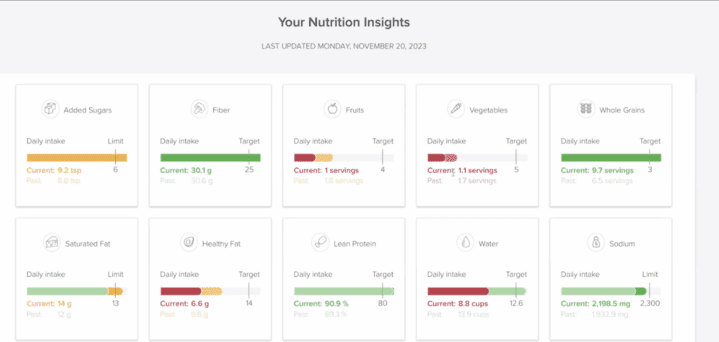
Foodsmart works through healthcare plans, where it is integrated into several large ones. Among their achievements, 39% of enrolled members bring their HbA1c under control after two years, and 33% with hypertension bring their blood pressure under control over an average of nine months. Most of their patients who lose weight have managed to continue doing so after three years.
Foodsmart is not a digital company, but apps and EHR integration enable its effects. They perform telehealth with dietitians and facilitate medical coding. EHRs that work with Foodsmart can preserve their dietary recommendations (foodscripts) as easily as a prescription.
They also identify patients likely to need food assistance by querying the EHR for medical information, including codes related to social determinants of health, traditional diagnosis codes, and prescriptions. They also take in patient-reported information, claims information, and data from other external sources. According to chief executive officer Dr. Jason Langheier, “Some information, like information on diagnosed chronic conditions such as diabetes, is straightforward to link to clinical programs, whereas other types of data require analytics on multiple data points to identify patients where food support is needed.”
Foodsmart also returns dieticians’ visit notes, weight and other biometrics, and other data to the referring physician and to other connected healthcare facilities, so that every healthcare provider can take food-related issues into account. Data that Foodsmart stores into the EHR includes standard biometrics such as weight and blood pressure, indicators on social determinants of health, dietary habitats, allergies, and cultural preferences.
Nourish employs 600 registered dieticians to offer hour-long, one-to-one telehealth visits that are covered by insurance. Its digital support includes monitoring, meal logging, meal planning, nudges, chats with dieticians, and a full library of resources that can be individually deployed based on what the patient’s are working on with their dietician (Figure 2). They measure outcomes both to evaluate the efficacy of individual dieticians and to monitor whole populations of patients to see whether protocols or clinical treatment pathways need to be modified to produce more optimal outcomes.

Dominique Adair, head of clinical quality, says they collect patient reports, data from EHRs, and clinician notes that they mine for food and activity-related information and behaviors, as well as clinical outcomes such as lipid markers, A1C, and blood pressure. In the future, they might also employ claims data and data from devices to continue building out their human-plus-tech solution to disease management.
As the final article in this series I’ll serve up a kind of dessert. We’ll look at digital tracking’s role in maintaining weight loss, and some issues of trust and privacy.
< + > Pelago Announces $58 Million Series C Funding to Strengthen Leadership in Substance Use Management
Investment Follows Strong Employer and Health Plan Demand as Substance Use Management Moves from Niche Solution to Essential Benefit Resulting in 287% Revenue Growth in 2023 and 100% Client Retention
Growth Follows 500% Increase in Substance Use Disorder-Specific RFPs from Employers and Payers in the Past Twelve Months
Platform Covers More than 3.4 Million Eligible Lives
Pelago, the leading digital clinic partner to U.S. businesses and health plans for substance use management, today announced $58 million in new funding on the strength of customer growth and validated ROI, bringing total funding to $151 million.
The additional capital raised will help Pelago accelerate its product roadmap, extend its continuum of care, and advance clinical research efforts. Existing investor Atomico doubled down to lead this Series C investment on the back of Pelago’s impressive growth, with participation from all existing investors Kinnevik AB, Octopus Ventures, and Y Combinator plus new investors Eight Roads and GreyMatter Capital. As part of this latest round, Atomico Partner Laura Connell will join the Pelago board.
“I’m so proud of the work we have done to improve lives and expand access to substance use care that works. We empower employers and payers to bring our solution to their members struggling with tobacco, alcohol, or opioids, from prevention to treatment and recovery,” said Pelago CEO and Co-Founder Yusuf Sherwani, M.D. “We’re addressing a gap in the market left by employee assistance programs and mental health benefits providers who are unable to detect and treat substance use disorders. Customers are resonating with our solution as evidenced by a tenfold growth in revenue and eligible lives since our Series B two years ago.”
Pelago was founded on the premise that substance use is a treatable chronic condition. The company is addressing the rising rates and costs of substance misuse head-on through its 100 percent fees-at-risk model that delivers improved outcomes and demonstrated ROI. In the industry’s first-ever substance use management medical claims analysis, Pelago’s substance use management program reduced medical claims on an annual basis by $9,367 per participant compared to a control group, delivering a 3.0x ROI. More than 80 percent of cost savings realized in the Pelago analysis were attributable to lower medical spend, with the remainder tied to lower behavioral health costs.
“Yusuf and the Pelago team are building the category-defining company in substance use management and in doing so, addressing one of this generation’s most urgent healthcare needs,” said Connell. “Their visionary leadership in the substance use management space, in offering treatment as an employee benefit to the world’s most forward-thinking companies, is reflected in their exceptional growth, a testament to the significant and rapidly growing demand for better solutions. Pelago’s ability to expand and accelerate access to best-in-class substance use care results in a major improvement in clinical outcomes and costs with clear and material ROI for employers. Atomico is incredibly proud to have supported the Pelago team on the journey thus far and to be doubling down on our partnership now.”
With rapidly rising healthcare costs, employers and health plans are laser-focused on value, cost-savings, and performance-based care for their employee and member benefits. According to recent surveys from consulting firms Mercer and WTW, costs for workplace health plans in 2024 will jump more than 6 percent. Moreover, recent Centers for Disease Control and Prevention research has reported the annual minimum direct cost of substance use disorders (SUDs) at $15,640 per affected employee enrolled in employer-sponsored insurance, totaling more than $35 billion annually.
In non-specialized SUD treatment settings, research shows up to 89% of adults with SUDs may go undetected, resulting in delays in treatment, relapse, and increased costs. And for those that do receive SUD treatment in mental health settings – the treatment itself is not the specialized SUD treatment they need. All the while, the consequences in terms of hidden financial and productivity impacts remain buried in medical claims and absenteeism, dramatically impacting a company’s bottom line in the form of costly health problems, inpatient and outpatient care, poor utilization management, and lower productivity.
“As a company that provides our employees with a broad range of health, life, and voluntary benefits, Live Nation Entertainment is proud to offer Pelago’s value-based, substance use management benefit,” said Emily Munroe, Director, Benefits for Live Nation Entertainment. “I congratulate Pelago on its funding raise, and I look forward to a continued strong relationship with their entire team.”
Pelago offers integrated substance use management to employer and health plan populations, with specialized treatment for tobacco, alcohol, and opioid use disorders along with support for adolescents. For more information, visit pelagohealth.com.
About Pelago
Pelago partners with enterprises as the leading virtual clinic for substance use management among their employees. We are transforming substance use support – from prevention to treatment – delivering education, management skills, and opportunities for positive change to members struggling with substance use, most commonly tobacco, alcohol, or opioids. Our solution gives employers the means to offer on-demand, personalized support to workers seeking to live healthier lives. Pelago’s cognitive behavioral therapy (CBT) and medication-assisted treatment (MAT) programs deliver convenient, accessible, and effective support that seamlessly integrates with health plans, pharmacy benefit managers, and wellness platforms. Tens of thousands of members enroll in the Pelago program each year, and more than 3.4 million now have access to the digital clinic.
Originally announced March 28th, 2024
Wednesday, May 1, 2024
< + > Ransomware was used in 72% of network intrusions last year, says BakerHostetler
While extortion continues to drive the work of cyber adversaries, organizations are restoring from attacks faster and making ransom payments less frequently than in years past, the data and security experts said.
Subscribe to:
Posts (Atom)