
Hospitals are exhausted by rip-and-replace software migrations. The multi-year implementations and budget overruns of the past decade left many organizations wary of adopting new core platforms. Yet clinical staff are desperate for modern user interfaces to reduce cognitive load and administrative bloat. Oracle is hoping to solve both problems at once.
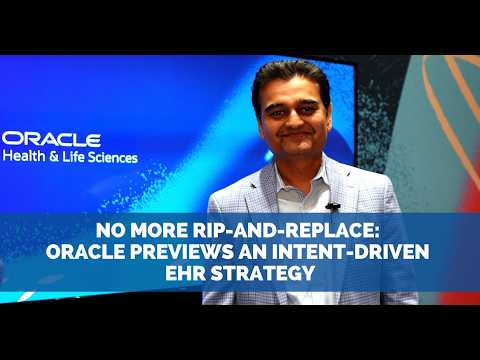
Healthcare IT Today sat down with Bharat Sutariya, SVP and Chief Medical Officer at Oracle, during the 2026 Oracle Health and Life Sciences Summit (OHLSSummit26). e discussed the central challenge of delivering next-generation clinical intelligence without forcing health systems into another painful data migration. Sutariya detailed how Oracle designed an intent-driven user interface and paired it with a measured rollout strategy to keep clinical operations stable.
Key Takeaways
- Phased rollouts prevent rip-and-replace panic. Forcing hospitals into massive data migrations creates internal resistance. Rolling out new capabilities venue by venue gives health systems a practical path forward without disrupting active clinical care.
- Intent-driven interfaces eliminate the traditional click hunt. Removing the traditional table of contents in favor of AI-generated, intent-based summaries drastically reduces the cognitive burden on staff. Modern EHRs must adapt dynamically to show context-specific data.
- Ambient listening is just the baseline for clinical AI. Saving time on note capture is great, but real value happens when voice technology goes further. Clinicians need tools that actively capture orders and navigate the record without third-party dictation software.
Protecting Clinical Stability
Forcing a hospital into a rip-and-replace migration often triggers immediate resistance from clinical staff. This is not surprising given the significant investments health systems already made to train users on their current platforms. Oracle adopted a measured migration strategy to address this operational reality directly.
Their new AI-first system can run alongside their legacy platform. Departments rolling out the software for the first time can adopt the latest version while their colleagues remain on the familiar interface.
“Our approach is to roll out by modules over a period of time,” Sutariya said. “The new EHR and the existing EHR coexist, and as we develop more and more of the new EHR capability, the existing Millennium EHR just deprecates and stops being used. We don’t want our customers to go through the data migration journey and the rebuild journey. It is important that we have a path for our customers in a non-disruptive way because it is not easy to transplant an EHR.”
Eliminating the Table of Contents
Physicians lose hours every week hunting through static menus just to compile a patient history. Oracle removed the standard navigation tree entirely from their new interface.
“What you will see is there is no table of contents in our new EHR,” explained Sutariay. “The new EHR is adaptive. If the view is about a summary, and a patient has three conditions, each of the three conditions is tagged and hyperlinked. If you now want to understand the summary of a COPD, you just click on it.”
This focused UI approach keeps the screen clean. It ensures the system only presents data relevant to the immediate clinical workflow.
Pushing Past Basic Ambient Scribes
Ambient listening technology is rapidly becoming an expected baseline feature. While capturing visit notes is helpful, it only solves a fraction of the daily clinical workload. Leaders want technology to move beyond basic documentation and actively drive administrative workflows.
“It’s great that we are capturing the note and saving doctors time, but as the clinician is talking, we are capturing their orders,” noted Sutariya. “We are capturing the finer points of their discussion. We are summarizing constantly for them.”
The UI is designed to have AI agents ready to execute the spoken commands of the clinician. This includes ordering labs, prescribing medications, and placing referrals without requiring a single click.
The Bottom Line
Oracle is deploying its new clinical platform with a strict focus on stability and practical adoption. They are avoiding the costly risk of forcing customers into massive software migrations. Health systems can adopt the clutter-free, intent-driven interface at their own pace. This approach delivers a modern system that understands clinical context and reduces cognitive burden without breaking active hospital operations.
Questions Healthcare IT Leaders Are Asking
Why are hospitals avoiding full EHR replacements? Health systems are fatigued by the massive capital costs and operational disruptions associated with completely replacing their core software. Instead of full migrations, organizations prefer vendors that offer phased rollouts and modular updates. This approach allows them to adopt new intelligence capabilities without throwing away years of customization and training on their legacy systems.
How do intent-driven interfaces reduce physician burnout? Traditional medical records force doctors to click through dozens of menus to find relevant lab results and historical notes. Intent-driven interfaces apply artificial intelligence to understand the clinical context and automatically present a synthesized summary of the patient’s current condition. This drastically reduces screen time and allows providers to focus directly on patient care.
What is the next evolution of AI scribes? Current ambient technology primarily focuses on listening to a patient encounter and generating a clinical note. The next phase involves using that same voice interaction to actively place medication orders, update specific problem lists, and navigate the record hands-free. This shifts the AI from a passive listener into an active workflow assistant.
Learn more about Oracle Health and Life Sciences at https://www.oracle.com/health/
Listen and subscribe to the Healthcare IT Today Interviews Podcast to hear all the latest insights from experts in healthcare IT.
And for an exclusive look at our top stories, subscribe to our newsletter and YouTube.
Tell us what you think. Contact us here or on Twitter at @hcitoday. And if you’re interested in advertising with us, check out our various advertising packages and request our Media Kit.
Oracle is a sponsor of Healthcare Scene.

No comments:
Post a Comment